


Top Orange Economy Jobs for College Students in 2026 Skills Salary and Growth
The career landscape is changing faster than college syllabi can keep up with. Every year, thousands of students graduate with degrees that once promised secure jobs, yet many struggle today to even receive interview calls. At the same time, a new category of careers is steadily opening doors for students who understand skills, creativity, and digital platforms. This shift is globally recognised as the Orange Economy.
For college students graduating in 2026, the Orange Economy is not a trend or a buzzword. It is already reshaping placements, freelancing opportunities, entrepreneurship, and campus hiring models. This blog is written to help students, parents, and colleges clearly understand what Orange Economy jobs are, which roles are growing fastest, what skills are required, how salaries are evolving, and how students can prepare while still in college.
Understanding the Orange Economy in Simple Terms
The Orange Economy refers to industries where value is created through creativity, ideas, content, culture, technology, and intellectual property. Unlike traditional jobs that rely heavily on physical effort or repetitive processes, these roles generate value through thinking, storytelling, design, innovation, and digital influence.
This economy includes fields such as content creation, digital marketing, media, design, gaming, animation, music, film, advertising, branding, user experience design, and several AI-enabled creative roles. What makes the Orange Economy especially powerful is that success does not depend on geography, college reputation, or marks alone. It depends on skills, execution, consistency, and real-world output.
Why Orange Economy Jobs Matter More in 2026
By 2026, automation and artificial intelligence will significantly reduce repetitive and routine jobs. However, roles that require creativity, communication, strategy, and human-centered digital skills will grow rapidly. Employers are no longer hiring candidates only for qualifications. They are hiring for measurable impact.
Students who understand Orange Economy careers early gain three major advantages. They are not limited to a single recruiter or a single placement season. They can earn even before graduation through internships, freelancing, or personal projects. Most importantly, they build long-term careers that grow with experience and skills rather than frequent job changes.
Students who understand off-campus strategy often secure multiple offers. Learn the exact approach inside the Off Campus Placement Secret E-Book.
Top Orange Economy Jobs for College Students in 2026
Digital Marketing Strategist
Digital marketing has evolved far beyond posting content or running ads. By 2026, companies expect professionals who understand audience psychology, digital platforms, data, and content strategy. A digital marketing strategist plans growth campaigns, manages brand positioning, and aligns marketing efforts with business goals. Students entering this field should focus on performance marketing, content strategy, analytics, SEO, and marketing automation. Entry-level salaries generally range between four to eight lakh per year, while skilled professionals earn significantly more through consulting and freelancing.
Content Creator and Content Strategist
Content is the foundation of the Orange Economy. From startups to global brands, every organisation needs storytelling that converts attention into trust and sales. Content creators work across blogs, videos, podcasts, short-form content, newsletters, and AI-assisted platforms. Students who build personal brands or niche expertise can begin earning during college itself. While income varies widely, consistent and skilled creators often earn between three to ten lakh annually, with strong long-term growth potential.
UI UX Designer
User experience design is one of the most stable and respected Orange Economy careers. As digital products continue to expand, companies need designers who understand human behaviour, usability, and aesthetics. This role blends creativity with psychology and technology. Students should develop skills in design tools, wireframing, user research, and basic frontend concepts. Entry-level salaries typically start around five lakh per year and grow rapidly with experience and portfolio strength.

Video Editor and Motion Designer
Video is the most consumed content format across industries. Brands, educators, influencers, and platforms rely heavily on video storytelling. As a result, skilled video editors and motion designers remain in constant demand. Students with strong editing abilities, storytelling sense, and software proficiency can earn through full-time roles, freelancing, or creator collaborations. Income growth depends on quality, speed, and niche specialization.
Social Media Manager and Community Builder
By 2026, social media management is no longer limited to posting content. It involves building communities, managing brand voice, handling online reputation, and converting engagement into business outcomes. This role requires creativity, discipline, analytics, and strong communication skills. Students who understand platform algorithms, content formats, and audience behaviour find steady opportunities across startups, agencies, and enterprises.
AI Assisted Creative Roles
Artificial intelligence has not replaced creativity; it has amplified it. New roles such as AI content specialist, AI video creator, prompt designer, and automation strategist are emerging rapidly. These roles combine creative thinking with AI tools to increase productivity and innovation. Students who learn to use AI ethically and effectively gain a significant advantage in the job market.
Game Designer and Interactive Media Creator
Gaming, animation, and immersive media are expanding globally. Game designers focus on storytelling, mechanics, user engagement, and interactive digital environments. This field is highly skill-driven and portfolio-based. While entry can be challenging, long-term growth is strong for students who remain consistent and committed.
Salary Reality and Growth Expectations
Salaries in the Orange Economy are not fixed like traditional jobs. Growth depends on skill depth, learning speed, and output quality. Many students begin with modest income but experience exponential growth within two to three years. Freelancing, consulting, and personal branding further increase earning potential. An important advantage of Orange Economy careers is the possibility of multiple income streams. A student can hold a job, take freelance projects, teach online, and build digital assets simultaneously.
Skills That Matter More Than Degrees
In the Orange Economy, degrees may open doors, but skills keep them open. Communication, consistency, problem-solving, creativity, adaptability, and digital fluency matter more than marks. Recruiters increasingly evaluate portfolios, live projects, and real work rather than certificates alone. Students should focus on learning by doing through internships, freelancing, volunteering, college projects, and personal experiments.
How College Students Should Prepare from Today
Preparation should start early. Understanding personal strengths and interests is the first step. Developing one core skill deeply is far more effective than learning many skills superficially. Building a portfolio, documenting work, and sharing learnings publicly helps establish credibility. Colleges that integrate practical exposure, industry projects, and skill-based learning consistently achieve better placement outcomes. Platforms like CollegePlacement.in aim to bridge the gap between education and industry by aligning student skills with future job demands.
The Emotional Reality for Students
Many students feel anxious as traditional placement opportunities shrink. The Orange Economy offers hope, but it also demands courage, patience, and consistency. Success is not instant. It rewards those who keep learning, experimenting, and improving even when progress feels slow. Every successful professional in the Orange Economy once started with uncertainty and limited resources. What made the difference was persistence and belief in skill development.
Building a creative career requires more than talent. The Professional Edge E-Book provides practical guidance to help students develop the mindset and skills needed for Orange Economy roles.

The Future of Placements
Placements in 2026 will not resemble placements of the past. Colleges that adapt to Orange Economy skills will empower students with sustainable and future-ready careers. Students who prepare early will not wait for opportunities. They will create them. The Orange Economy is no longer an alternative career path. It is becoming the mainstream. Those who understand this shift today will shape the workforce of tomorrow.
College Placement remains committed to guiding students, colleges, and educators through this transition by focusing on future-ready skills, real opportunities, and honest career guidance.
If you see yourself building a career in digital marketing, content creation, UI UX design, video editing, social media strategy, AI-driven roles, or any other Orange Economy field, do not wait for placement season to decide your future. The students who succeed in 2026 will be those who prepare early and strategically. Send your updated resume to CollegePlacement.in for professional review and career alignment guidance based on future-ready skills. A timely decision today can significantly strengthen your placement outcomes tomorrow.
FAQ
Can students from any degree enter Orange Economy jobs
Yes. These careers focus more on skills, portfolios, and real work than on degree specialization.
What skills are required for Orange Economy jobs
Digital skills, creativity, communication, consistency, problem-solving, and the ability to learn and adapt continuously.
Is the Orange Economy a stable career option
Yes. With continuous learning and skill upgrading, Orange Economy careers offer long-term stability and growth.
- Google Summer Internship 2026
Big Opportunity for 2nd Year Engineering Students in India
There is a moment in every student’s life when effort meets opportunity. For many, Google Summer Internship 2026 can be that moment. If you are a 2nd year Computer Science or Engineering student, Google has opened an exciting opportunity for Summer 2026. The Google Associate Software Developer Internship 2026 (India) is designed to give students early exposure to real-world software development, mentorship from top engineers, and hands-on project experience. This internship can change your placement journey if you start preparing now.
Why This Google Internship Matters More Than You Think
Most students think internships are only about certificates. They are wrong. A Google Associate Software Developer Internship is about:
- Confidence
- Clarity
- Career direction
- And self-belief
When a recruiter sees Google on your resume, they don’t ask where you studied —
they ask what you learned.About Google Summer Internship 2026 (India)
Google has announced the Associate Software Developer Internship 2026 to support and nurture future software engineers.
Internship Snapshot:
- Role: Associate Software Developer Intern
- Duration: 10–12 weeks
- Start: May 2026
- Type: Full-time Summer Internship
- Locations in India:
- Bengaluru, Karnataka
- Hyderabad, Telangana
- Pune, Maharashtra
During the application, you can share your preferred location.
Who Is This Internship Really For?
This internship is intended for 2nd year students who are:
- Pursuing a Bachelor’s degree
- Majoring or intending to major in:
- Computer Science
- Information Technology
- Software Engineering
- Related technical fields
- Comfortable with at least one programming language
- Able to communicate in English for technical discussions
Your college tier does not define your eligibility. Your preparation does.
Documents You Must Prepare (Non-Negotiable)
Before applying, ensure you have:
- A clear, updated Resume / CV (English)
- Your latest academic transcript (English)
A one-page resume with real projects and skills can change your destiny.
Want to increase your chances of getting a Google internship? Get your resume reviewed now. Resume writing & review form.
Minimum vs Preferred Qualifications
Minimum Qualifications (Must Have):
- Enrolled in a Bachelor’s program
- Basic programming experience
- English communication skills
Preferred Qualifications (What Makes You Stand Out):
- Full-time student returning after internship
- Available for 10–12 weeks (May–August 2026)
- Strong coding in:
- C++
- Java
- Python
Google prefers clarity over perfection.
What Will You Actually Do at Google?
This is not a training internship where you sit idle. As an Associate Software Developer Intern, you will:
- Work on a real development project
- Collaborate with Googlers
- Write production-quality code
- Learn debugging, scalability, and best practices
- Understand how products used by billions are built
You will contribute, not observe.

Mentorship That Changes How You Think
Every Google intern:
- Is paired with a Google Engineer
- Attends technical talks by senior leaders
- Learns directly from people who build:
- Google Search
- Android
- Chrome
- YouTube
- Google Ads
You don’t just learn code — you learn how engineers think.
Why Google Is Different
Google is an engineering-first company. Engineers at Google:
- Solve massive real-world problems
- Build scalable systems
- Create platforms for developers worldwide
- Change lives through technology
If you want to grow where learning never stops, Google is that place.
Responsibilities (What Google Expects From You)
Your responsibilities depend on the project, but usually include:
- Writing clean, efficient code
- Improving existing systems
- Debugging and optimizing solutions
- Collaborating with cross-functional teams
- Learning fast and adapting faster
How Google Internship Transforms Your Placements
Let me be honest with you. Students with Google internship experience:
- Get shortlisted faster
- Receive higher salary offers
- Perform better in interviews
- Gain confidence others struggle with
- Often receive Pre-Placement Offers (PPOs)
This internship can rewrite your placement story.
Focus on:
- Data Structures & Algorithms
- One strong programming language
- 2–3 meaningful technical projects
- Problem-solving mindset
- Consistency, not comparison
One hour daily beats ten hours once a week.
You don’t need to be from an IIT.
You don’t need perfect marks.
You don’t need shortcuts.You only need:
- Discipline
- Direction
- And belief
Google does not look for the best students —it looks for students who can become the best.
The Google Summer Internship 2026 for 2nd year students is not just an opportunity. It is a mirror — showing you what you are capable of becoming. Prepare with honesty. Apply with confidence.
Frequently Ask Questions by Students (FAQs)
1.Do I need to be from IIT or a top college to get into Google?
No. Google does not filter students by college name. Skills, projects, and coding ability matter more than your college tag.
2.What is the minimum CGPA required for Google Summer Internship?
Google has no fixed CGPA cutoff. A decent academic record with strong technical skills is enough.
3.Is Google Summer Internship 2026 very hard to crack?
It is competitive, not impossible. Students who practice DSA consistently and understand core concepts have a strong chance.
4.Does Google internship guarantee a job or PPO?
There is no guarantee, but strong performance can lead to a Pre-Placement Offer (PPO) or future interview advantages.
5.How many coding questions are asked in Google internship interviews?
Usually 1–2 problem-solving questions per interview, focusing on logic, data structures, and approach rather than syntax.
6.Which language is best for Google internship preparation?
Any one language is enough if you are strong in it. Python, Java, or C++ are most commonly used.
7.Can I apply if I have no prior internship experience?
Yes. Google values potential and learning mindset more than past internships.
- MHA Cyber Crime Internship 2025
MHA Cyber Crime INTERNSHIP: Step Into India’s Digital Defense Network
In an era where cyber threats loom large and digital security is paramount; the Ministry of Home Affairs (MHA) has opened its doors to the next generation of cyber defenders. The Cyber Crime Internship 2025, hosted by the Indian Cyber Crime Coordination Centre (I4C), is a prestigious opportunity for students to gain firsthand experience in tackling real-world cybercrime challenges.
Whether you’re a tech enthusiast, a budding forensic analyst, or a law student curious about cyber legislation, this internship is your gateway to contributing to India’s digital safety.
What Is the MHA Cyber Crime Internship?
The Cyber Crime Internship Program is a flagship initiative by the MHA under its I4C framework. It’s designed to immerse students in the dynamic world of cybercrime investigation, digital forensics, and cybersecurity policymaking.
The internship is offered in two cycles:
- Summer Batch: April to September
- Winter Batch: October to March
Applications for the Winter 2025 cohort are now open, with a submission deadline of October 17, 2025.
Purpose Behind the Program
This internship isn’t just about learning—it’s about contributing. The MHA aims to:
- Equip students with practical skills in cybercrime detection and analysis
- Foster research and innovation in cybersecurity
- Build a talent pool for future roles in digital law enforcement
- Promote awareness of cyber laws and ethical hacking
Interns will work on live projects, assist in investigations, and explore the intersection of technology, law, and national security.
Who Can Apply?
The program welcomes applications from students pursuing:
- Undergraduate (UG) degrees
- Postgraduate (PG) degrees
- Doctoral (PhD) programs
Eligible disciplines include:
- Computer Science & Engineering
- Information Technology
- Electrical & Electronics Engineering
- Cyber Law
- Digital Forensics
- Artificial Intelligence
- Data Science
Applicants must be enrolled in recognized institutions and demonstrate a strong academic record and interest in cybersecurity.
How to Apply
Here’s a step-by-step guide to submitting your application:
- Visit the official I4C portal: i4c.mha.gov.in
- Download the application form
- Fill in your academic and personal details
- Attach the required documents:
- Resume
- Academic transcripts
- Identity proof
- Recommendation letter (optional but recommended)
- Submit your application before October 17, 2025
Shortlisted candidates will be notified within 4–5 weeks after the deadline.
What You’ll Gain
Interns will be exposed to:
- Cybercrime investigation protocols
- Digital evidence handling and analysis
- Threat intelligence and malware tracking
- Cyber law and policy frameworks
- Real-time monitoring of cyber threats
You’ll also participate in workshops, contribute to research papers, and collaborate with experts from law enforcement and tech sectors.
Internship Format
The internship is structured to maximize learning and impact:
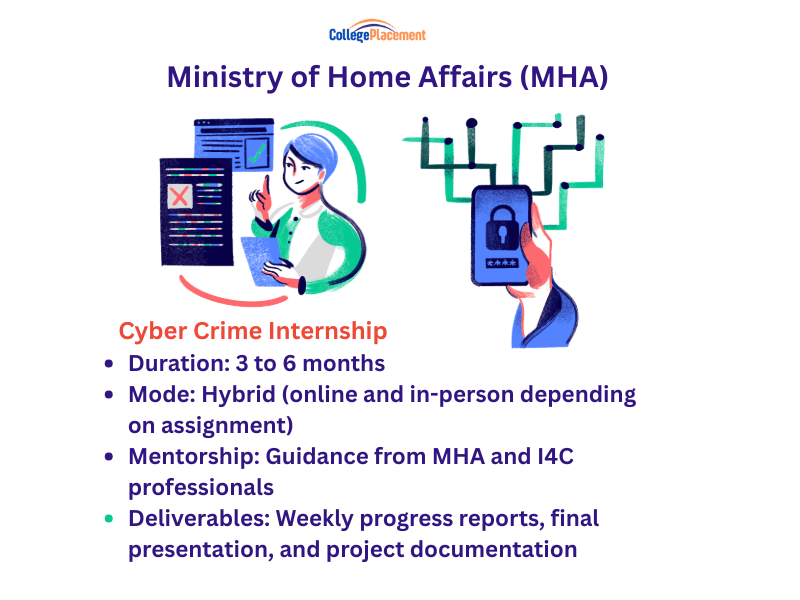
- Duration: 3 to 6 months
- Mode: Hybrid (online and in-person depending on assignment)
- Mentorship: Guidance from MHA and I4C professionals
- Deliverables: Weekly progress reports, final presentation, and project documentation
Interns may be placed in specialized units such as:
- Cyber Threat Intelligence
- Digital Forensics Lab
- Legal & Policy Analysis
- Outreach & Awareness
Perks and Recognition
While the internship is unpaid, it offers several career-boosting benefits:
- Certificate of Completion from MHA
- Letter of Recommendation for top performers
- Networking opportunities with cybersecurity experts
- Access to exclusive training sessions
- Priority consideration for future government roles
These credentials are highly valued by employers in cybersecurity, law enforcement, and policy-making.
Why This Internship Matters
India’s digital landscape is expanding rapidly—and so are the threats. From phishing scams to ransomware attacks, cybercrime is evolving. This internship empowers students to:
- Understand the anatomy of cyber threats
- Contribute to national digital safety
- Develop skills that are in high demand globally
It’s not just an internship—it’s a mission to safeguard India’s cyberspace.
Tips to Strengthen Your Application
To stand out:
- Highlight relevant coursework and certifications (e.g., CEH, CISSP, CompTIA Security+)
- Showcase personal projects or hackathon experience
- Write a compelling Statement of Purpose
- Secure a strong recommendation from a faculty member
- Demonstrate awareness of current cybercrime trends
Career Pathways After the Internship
This internship can be a launchpad for careers in:
- Cybersecurity Analyst
- Digital Forensics Expert
- Cybercrime Investigator
- Cyber Law Consultant
- Ethical Hacker
- Policy Advisor
Many interns also pursue advanced degrees or certifications in cybersecurity, law, or public policy.
The MHA Cyber Crime Internship 2025 is a rare opportunity to work at the intersection of technology, law, and national security. For students passionate about digital safety, this program offers real-world exposure, expert mentorship, and a chance to make a meaningful impact.
Whether you’re a student, educator, or recruiter, this internship deserves your attention. Let’s build a safer digital India—one intern at a time.
Would you like me to turn this into a downloadable brochure, LinkedIn post, or email announcement for your college placement cell?
FAQs
What is the MHA Cyber Crime Internship?
It’s a government-sponsored internship by the Ministry of Home Affairs (MHA), offering hands-on experience in cybercrime investigation, digital forensics, and cybersecurity.
Who can apply?
Students pursuing undergraduate, postgraduate, or PhD programs in fields like law, IT, computer science, or cybersecurity. A maximum of 25 UG, 15 PG, and 10 PhD interns are selected per session
What are the internship durations?
There are two sessions:
Winter Internship: October to March
Summer Internship: April to September
Is the internship paid?
Yes, it is a paid internship. Specific stipend details may vary by session
How do I apply?
Applications are typically submitted via the AICTE internship portal or the official MHA site. Keep an eye on i4c.mha.gov.in for announcements
read more
MHA Cyber Crime Internship 2025
MHA Cyber Crime INTERNSHIP: Step Into India’s Digital Defense Network In an era where cyber…
IndiaAI FutureSkills FELLOWSHIP FOR PG Students
IndiaAI Future Skills Fellowship is transforming postgraduate education by offering students across India the opportunity…
What Is the Google Apprenticeship Selection Procedure?
Google Apprenticeships are one of the most sought-after opportunities for students and fresh graduates worldwide….
Latest Post
- IndiaAI FutureSkills FELLOWSHIP FOR PG Students
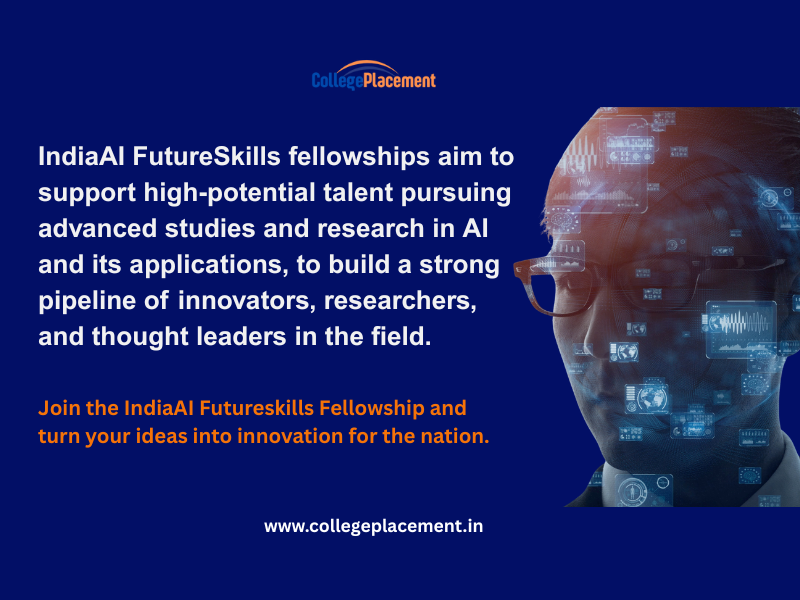
IndiaAI Future Skills Fellowship is transforming postgraduate education by offering students across India the opportunity to engage in cutting-edge Artificial Intelligence (AI) research and application. This initiative, launched by the Government of India under the IndiaAI Mission, aims to bridge the gap between academic learning and real-world AI deployment.
What Is the IndiaAI FutureSkills Fellowship?
The fellowship is designed to support postgraduate students pursuing AI-related projects, enabling them to contribute to India’s growing AI ecosystem. By providing financial assistance, mentorship, and exposure to industry practices, the program empowers students to become leaders in AI innovation.
Eligibility Criteria
Academic Requirements
Admission Status
- Must have confirmed admission to a PostGraduate program
Application Timeline
- Applications accepted during 1st, 2nd, or 3rd semester only
Academic Performance
- Minimum 80% (or equivalent grade) in undergraduate degree
- For 2nd/3rd semester applicants: Minimum 75% in postgraduate studies through last completed semester
Program Scope
Eligible Disciplines Students from all academic backgrounds are welcome, including:
- Technical fields (Engineering and Sciences)
- Medicine
- Law
- Commerce and Business
- Liberal Arts
- Other disciplines
Project Focus
Must undertake AI-based projects or projects in AI-related domains
Additional Requirements
Study Mode
- Full-time students only (part-time students not eligible)
Nationality
- Open to Indian Nationals exclusively
Fellowship Benefits
Selected fellows receive:
- Financial support up to ₹2 lakh, disbursed in tranches based on project milestones.
- Additional support up to ₹1 lakh for travel and accommodation to present their work at conferences or events.
- Mentorship from leading AI researchers and industry experts.
- Opportunities to collaborate with top-tier academic and research institutions.
Areas of Focus
The fellowship encourages projects in various AI domains, including but not limited to:
- Machine Learning and Deep Learning
- Natural Language Processing
- Computer Vision
- Robotics and Automation
- AI Ethics and Responsible AI
Application Process
The application process involves:
- Project Proposal Submission: Students submit detailed proposals outlining their AI projects.
- Selection Committee Review: A panel of experts reviews applications based on innovation, feasibility, and alignment with national AI priorities.
- Announcement of Fellows: Selected fellows are notified and commence their projects.
Why Apply?
Participating in the IndiaAI FutureSkills Fellowship offers:
- Hands-on experience in AI research and development.
- Exposure to the latest AI tools and technologies.
- Networking opportunities with professionals and researchers in the AI field.
- Enhanced career prospects in academia, industry, or entrepreneurship.
If you’re a postgraduate student passionate about AI and innovation, consider applying for the IndiaAI FutureSkills Fellowship. This is your chance to contribute to India’s AI future and advance your career in a rapidly evolving field.
For more information and to apply, visit the official IndiaAI portal.
Related BLOG
- What Is the Google Apprenticeship Selection Procedure?
Google Apprenticeships are one of the most sought-after opportunities for students and fresh graduates worldwide. With programs in Digital Marketing, Project Management, Data Analytics, IT Support, and UX Design, apprenticeships provide hands-on training, mentorship, and real-world experience at Google.
But how does the selection process actually work? What are the interview rounds like? And how can you prepare to increase your chances of success?
This blog will break down the complete Google Apprenticeship selection journey (2026 edition) — from application to final offer.
Step 1: Online Application
The process begins with submitting an application through the Google Careers portal.
Documents Required:
- Updated Resume (ATS-friendly, skill-focused).
- Academic Transcripts (if applicable).
- Portfolio or Projects (for roles like UX design, Data Analyst).
Tips for Application
- Tailor your resume to highlight skills relevant to the apprenticeship (Google looks for potential, not just degrees).
- Add certifications like Google Career Certificates (Digital Marketing, Data Analytics, Project Management).
- Highlight any internships, freelancing, volunteering, or personal projects.
Step 2: Resume Screening
After submission, Google recruiters shortlist resumes based on:
- Skills (technical + transferable).
- Relevant coursework/projects.
- Certifications (especially Google ones).
- Experience with tools (Google Ads, SQL, Tableau, Python, etc., depending on track).
Only a small percentage of applicants move forward — make sure your resume is concise, relevant, and achievement-driven.
Step 3: Online Assessments
If shortlisted, you’ll receive an invitation for online assessments. These are usually skill-based and differ by apprenticeship program.
Common Assessment Types:
- Aptitude Tests
- Logical reasoning, problem-solving, and numerical ability.
- Tests your ability to think analytically.
- Role-Specific Tests
- For Data Analytics: SQL queries, data cleaning tasks, Excel exercises.
- For Digital Marketing: Case studies on ad campaigns, SEO/SEM basics.
- For Project Management: Situational judgment questions.
- Behavioral Situational Judgment Test (SJT)
- Hypothetical workplace situations.
- Tests teamwork, adaptability, and decision-making.
Practice with Google’s free skill assessments on Grow with Google or LinkedIn Learning.
Step 4: Phone / Video Interview
If you clear the assessments, you’ll move on to interviews with recruiters. These are usually virtual interviews (Google Meet/Phone).
Format:
- 30–45 minutes
- Combination of behavioral + role-related questions
Example Behavioral Questions:
- Why do you want to join Google Apprenticeship?
- Tell me about a time you solved a complex problem.
- How do you handle challenges while working in a team?
Example Role-Specific Questions:
- Digital Marketing: “How would you improve the performance of an ad campaign?”
- Data Analytics: “Explain how you would clean a dataset with missing values.”
- Project Management: “How would you prioritize tasks in a project with tight deadlines?”
Use the STAR Method (Situation, Task, Action, Result) for structured answers.
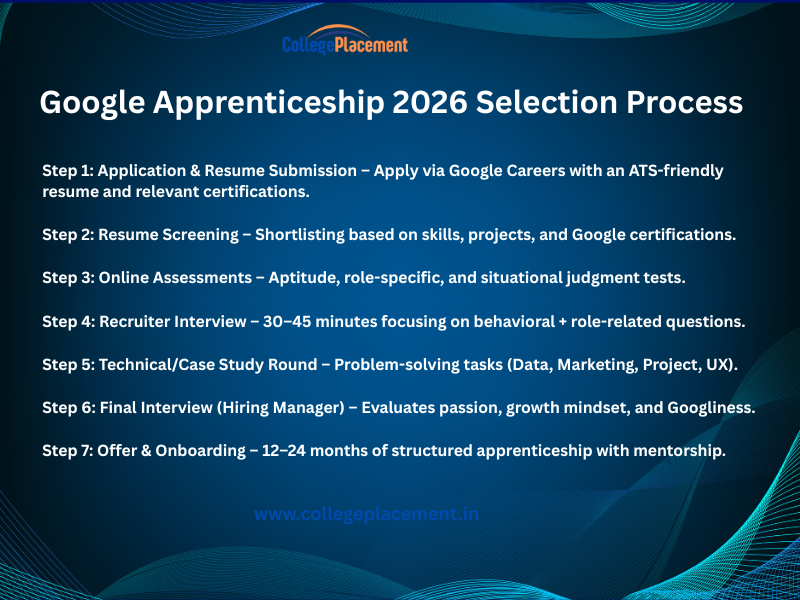
Step 5: Technical/Case Study Round
For technical apprenticeships (Data Analytics, UX, IT Support), candidates may face a case study or technical interview.
Examples:
- Data Analytics: Given a sales dataset, identify trends and create a simple visualization.
- Project Management: Draft a plan to launch a product within 2 months.
- Digital Marketing: Suggest an online strategy for a startup to increase traffic.
Don’t just give answers — explain your thought process clearly. Google values clarity + problem-solving.
Step 6: Final Interview (Hiring Manager)
This is the last stage, where you interact with the hiring manager and sometimes a team member.
What They Evaluate:
- Passion for the role.
- Growth mindset and willingness to learn.
- Cultural fit with Google’s values (“Googliness” – curiosity, collaboration, innovation).
- Long-term interest in the field.
Be authentic. Share how you’ve been learning and how you’ll apply your skills during the apprenticeship.
Step 7: Offer & Onboarding
If you clear all rounds — congratulations! You’ll receive an official apprenticeship offer.
- Duration: 12–24 months (depending on program).
- Training: Combination of classroom learning + on-the-job training.
- Perks: Competitive stipend, mentorship, and access to Google resources.
After that, onboarding begins with orientation, team introductions, and training modules.
Timeline of Selection Procedure (Approx.)
- Application Open: Sept 2025
- Resume Shortlisting: Nov 2026
- Assessments: Dec 2026
- Interviews: Dec–Feb 2026
- Final Results: Feb-March2026
- Onboarding: March-April 2026
Pro Tips to Succeed in Google Apprenticeship Selection
- Start Early – Prepare at least 5–6 months before applications open.
- Earn Certifications – Google Career Certificates or Coursera ones add weight.
- Build a Portfolio – Even small projects on GitHub, Behance, or LinkedIn help.
- Mock Interviews – Practice behavioral + technical questions with peers.
- Network – Connect with past apprentices on LinkedIn and learn from their journey.
- Stay Updated – Follow Google Careers and Apprenticeship pages regularly.
The Google Apprenticeship selection process is competitive but achievable with the right preparation. It’s not just about technical skills — recruiters also look for problem-solving ability, communication, and adaptability.
By building your skills, showcasing projects, and preparing for interviews with confidence, you can greatly improve your chances of success in Google Apprenticeship 2026.
Remember — every round is a chance to show your potential, passion, and willingness to learn. Stay connected via college placement social media platform, start today, stay consistent, and your dream apprenticeship at Google could be just months away!
RELATED TO THIS BLOG
Complete Guide to top Govt Apprenticeships Schemes in India
How can Google Apprenticeship 2026 shape your tech career
- Prime Minister Internship Scheme: complete guide
Internships have become an integral part of every student’s journey toward building a successful career. Understanding the need for practical exposure, the Government of India launched the Prime Minister Internship Scheme to help students gain hands-on experience while contributing to the nation’s development. This initiative aims to bridge the gap between academic knowledge and real-world applications, ensuring that young India is better prepared for the challenges of the future.
In this blog, we will explore everything you need to know about the Prime Minister Internship Scheme – its objectives, benefits, eligibility, application process, and how it can shape your career.
1. What Is the Prime Minister Internship Scheme?
The Prime Minister Internship Scheme (PMIS) is a flagship initiative by the Government of India (via the Ministry of Corporate Affairs). Launched in October 2024, the scheme aims to provide hands-on industry experience to students and fresh graduates through internships in India’s top 500 companies. Over five years, it aims to offer up to 1 crore internships to youth across sectors.
2. Why It Matters for College Students
- Bridges the gap between theoretical learning and real-world work
- Provides exposure to corporate culture, mentorship, and networking
- Equips you with hands-on skills in sectors like marketing, finance, governance, tech, and more
- Adds a government-recognized certification to your resume
3. Who Can Apply? Eligibility Criteria
To apply for PMIS, you must meet these criteria:
- Age: Between 21 and 24 years (some sources allow up to 30)
- Education: Completed any of the following:
- 10th or 12th pass, ITI certificate, Polytechnic diploma
- Undergraduate degree (BA, B.Sc, B.Com, BBA, BCA, B.Pharma, etc.)
- Postgraduate degree in select cases
- Status: Should not be engaged in full-time employment or a full-time degree (online/distance learners allowed)
- Citizenship: Must be an Indian resident with Aadhaar linkage
- Excluded: Students already in government apprenticeships or scholarship schemes
4. Benefits for College Students
- Monthly stipend: ₹5,000 from the government, plus a one-time ₹6,000 grant for incidentals
- Insurance: Coverage under Jeevan Jyoti Bima Yojana and Suraksha Bima Yojana
- Certificate: Government-issued internship certificate after completion
- Internship options: Opportunities span over 500 companies in sectors like tech, banking, energy, policy, manufacturing, and more

5. Timeline & Application Process
- Scheme announcement: Union Budget 2024–25; portal launched October 2024
- Pilot (Round 1): 1.25 lakh internships, >6 lakh applications across 745 districts
- Round 2 opened Jan–Mar 2025, offering ~1 lakh+ internships across 730+ districts
- Registration portal: pminternship.mca.gov.in needs online profile, Aadhaar verification, SOP, and document upload
- Last known registration: Extended to end of March 2025 (Phase II) and deadlines have been updated per phase
6. Step-by-Step Application Guide for Students
- Register on the PMIS portal with Aadhaar and email/mobile
- Fill your profile, including academic details and SOP (statement of purpose)
- Browse internship opportunities from 500+ companies across sectors
- Apply to relevant postings; waitlist or shortlist-based selection
- Selection process may include further screening or interviews
- If selected, internship may begin with stipend disbursal and assigned period
- Completion leads to government-issued certificate & experience letter
7. Tips to Improve Selection Chances
- Craft a strong SOP: Highlight relevant skills, why you choose that sector, and learning intent
- Customize your profile: Align interests with internship categories (marketing, policy, digital)
- Learn soft skills: Communication, basic Excel/Analytics, domain awareness
- Stay updated with latest deadlines (the portal opens in waves for phases)
- Apply early: Top internships fill up quickly during each round
8. Sample Scenarios for College Students
Discipline Possible Internships What You Gain B.Com / BBA Financial services, Banking, CSR teams Corporate environment, finance skills BCA / B.Tech IT, digital transformation, software firms Coding exposure, collaborative projects Humanities / Policy Govt ministries, Think tanks, NGOs Policy insight, research & writing Marketing / Arts Brand teams, Ad agencies, Social initiatives Campaign design, content creation 9. FAQs — Quick Clarifications
Q. Are reservations applicable?
No explicit government quotas—but companies may ensure diverse representation.Q. Do internships guarantee full-time employment?
No guaranteed job. But strong performance may lead to full-time offers or high-profile references.Q. Can first- or second-year students apply?
Typically, no. Eligibility is for final-year or recent graduates aged 18–30 and not in full-time programmes.The Prime Minister Internship Scheme offers Indian college students a powerful platform to gain hands-on experience, earn a stipend, and build their professional network at top-tier companies. If you’re eligible (aged 21–24, recent graduate or final year student), applying early and aligning your application with your skills and SOP can open transformative opportunities.
By blending government mentorship exposure with real-world work, PMIS can be your steppingstone to stronger career readiness—and even future job placements.
Interested in applying to PMIS? Need help drafting your SOP or choosing relevant internships?
Email us at info@collegeplacement.in for personalized assistance and expert guidance on the application process.Read More
Complete Guide to top Govt Apprenticeships Schemes in India
- How can Google Apprenticeship 2026 shape your tech career
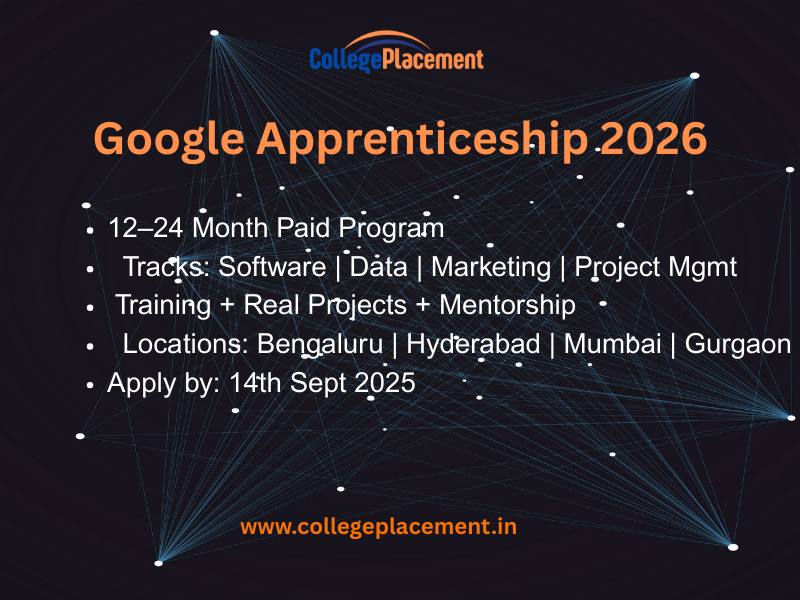
Google’s Apprenticeship Programs for March 2026 are a rare opportunity for fresh graduates and early career professionals in India to gain real-world experience, paid training, and a potential fast-track into a full-time role at a global tech giant. With tracks in Software Application Development, Data Analytics, Project Management, and Digital Marketing, these programs—running 12 to 24 months—combine hands-on experience with focused training and mentorship. Let’s explore what each track offers and how to make the most of this golden opportunity.
1. What Google is Offering: Program Tracks & Duration
Software Application Development Apprenticeship
- Duration: 12 months (full-time, ~40 hrs/week)
- Model: Hybrid—part office, part training; cannot relocate mid-program
- Structure: ~20% classroom or online training; ~80% real project work with Google teams
Data Analytics Apprenticeship
- Duration: 24 months, same full-time hybrid format
- Focus: Data cleaning, analysis, visualization, SQL, generating insights
Project Management & Digital Business Marketing Apprenticeships
- Duration: 24 months each
- Digital Marketing: Google Ads campaigns, SEO, client account management
- Project Management: Planning, risk management, coordination, documentation best practices
All tracks follow a hybrid model, requiring regular in-office attendance at one of Google’s locations in Bengaluru, Hyderabad, Mumbai, or Gurgaon.
2. Eligibility & Application Timeline
Eligibility Criteria (General)
- Bachelor’s degree in a relevant field or equivalent practical experience.
- Less than 1 year of post-graduation experience for Software & Data Analytics tracks; at least 1 year for Project Management & Marketing roles
- No prior participation in a Government Apprenticeship program
- Aadhaar must be linked to an active mobile number, and a personal email ID is mandatory for registration & verification
- Fluency in English (spoken and written) to understand training materials and collaborate effectively
Preferred Qualifications
- Software track: programming knowledge in Java, C++, or Python; basic understanding of Google Workspace tools
- Data Analytics: familiarity with SQL, spreadsheets, and analytical thinking
- Project & Marketing: experience from any industry; interest in stakeholder communication and strategy.
Apply By
- Deadline: September 14, 2025
- Expected Duration of selection process: 18–24 weeks (4–6 months) – plan accordingly.
3. What’s Inside the Program: Learning & Responsibilities
Training & Mentorship
- Apprentices spend around 20% of their time in structured training, covering technical tools, coding standards, soft skills, and domain concepts
- The remainder (80%) is hands-on project work: write, test, integrate code; analyze data; plan and coordinate tasks; design campaigns.
Technical Responsibilities & Exposure
- Software Track: Write clean, tested code following Google standards; participate in code reviews; debug and optimize; integrate features
- Data Analytics: Identify data anomalies; create dashboards and reports; apply business logic to data insights; use SQL & visualization tools
- Project Management: Track tasks, manage stakeholders, plan sprints, generate status documentation, manage risk and resources
- Marketing: Plan campaign strategies, use Google Ads, analyze performance metrics, manage client accounts, deliver recommendations
Certification & FTE Opportunity
- Successful completion comes with a Google certificate and eligibility to apply for full-time roles during the final three months of the program
- While not guaranteed, high-performing apprentices often secure Full-Time Employee (FTE) roles at Google.
4. Why Choose Google Apprenticeship?
hands-on with World-Class Teams
You’ll directly contribute to impactful projects under Google’s mentorship. This kind of institutional exposure is rare for early career professionals.
Structured Learning + Real Workload
Google’s apprenticeship blends guided training with real tasks—so you’re learning while delivering value.
Global Credibility
Whether or not you land a full-time job at Google, the apprenticeship certification sends a strong signal to future employers all around the world.
Versatility of Tracks
Choose from software engineering, analytics, project management, or digital marketing—matching your passion and skill set.
Career Transition Friendly
Even if you graduated in a non-tech field, Google encourages applicants with equivalent practical experience—even personal projects.
5. Who Should Apply? Target Audience
Track Ideal Candidate Software Development New grads in CS/Engineering or coding hobbyists with basic experience in Java, Python, or C++ Data Analytics Candidates with an aptitude for data, basic SQL/spreadsheet experience, analytical mindset Project Management Candidates from any industry with organizational, communication skills, and risk-management interest Digital Marketing Those curious about digital campaigns, metrics, Google Ads, SEO, and creative strategy If you’ve participated in personal coding projects, analytics assignments, event coordination, internships, or freelanced in digital marketing—you’re a potential fit.
6. Application & Preparation Tips
Craft a Strong Profile & Resume
Highlight degree, GPA, practical projects, internships, GitHub repos, Kaggle notebooks, or campaign results. Ensure clarity and ATS compatibility.
Check Eligibility
Ensure your Aadhaar is linked to an active mobile number and you have a valid personal email ID. Do not apply if you have prior government apprenticeship experience.
Brush Up Skills
- Software: Practice coding in Java, Python, or C++; understand basic algorithms and data structures.
- Analytics: Refresh SQL basics, Excel or Google Sheets, simple visualization tools.
- Project/Marketing: Learn basics of Google Workspace, project planning tools, Google Ads platform if possible.
Show Interest & Initiative
Express passion for technology, digital trends, or business processes—through online course certificates, personal blogs, or volunteer work.
Plan Ahead
The selection process may take up to six months. Apply early, and keep communication channels open in case of Google’s reach-outs.
Location Considerations
You’ll be offered preference for Bengaluru, Hyderabad, Mumbai, or Gurgaon. If you live more than 100 km away from your assigned office, Google may provide relocation assistance—so research commuting logistics in advance.
7. What to Expect Year-by-Year
Software Apprenticeship (12 Months)
- Months 1–3: Onboarding, training in coding standards, basic architecture
- Months 4–9: Assigned to a team, contribute to modules, write unit tests, participate in releases
- Months 10–12: Final evaluation, certification, FTE application window opens
Analytics / PM / Marketing (24 Months)
- Months 1–6: Foundation training, domain-specific tools (SQL, project methodologies, campaign tools)
- Months 7–18: Live project contributions, stakeholder interactions, performance dashboards
- Months 19–24: Capstone assignments, team leadership, value-impact analysis, FTE application process
8.FAQs & Myths Debunked
Q: Is relocation supported?
A: Only for candidates relocating over 100 km—pending approval, not for those assigned offices new during program.Q: Are these permanent roles?
A: No—they are paid apprenticeships, not full-time roles. But you can apply for FTE openings during final months based on performance.Q: What happens if I leave early?
A: You generally must complete the full duration (12 or 24 months) to receive the certificate and access FTE options.Q: Is prior internship mandatory?
A: Not necessarily equivalent practical experience such as self-learning, coding challenges, or freelance work may suffice.9. How to Stand Out in the Selection Process
- Demonstrate self-motivated learning (GitHub activity, Kaggle, course certificates)
- Show clarity about why you want the specific track (software vs analytics vs PM vs marketing)
- Showcase problem-solving approach in interviews or written assessments
- Highlight teamwork and communication folded into technical or domain-based answers
- Be ready to talk about Google Workspace tools, basic project planning, or campaign metrics—even if informal
10. Your Roadmap to Google Apprenticeship 2026
- Check eligibility: degree, Aadhaar linkage, no prior government apprenticeship
- Prepare application materials: resume, project portfolio, personal email
- Choose your track wisely: match your background and passion
- Apply on Google Careers before September 14, 2025
- Prep for coding/data/PM/marketing assessments: brush up on basics
- Stay engaged during selection: monitor email and stay flexible
- Once accepted: commit fully—attend training & team projects on time
- Perform well in mid-term reviews to become eligible for FTE slot
- Apply for full-time Google roles during final three months of apprenticeship
- Leverage your apprenticeship certificate—even afterward—for global resume value
Google’s Apprenticeship Programs launching in March 2026 offer an unmatched bridge between graduation and global-scale professional experience. You’ll earn while learning, build credible accomplishments, and get real exposure inside a tech powerhouse. And unlike unpaid internships, this is a structured, paid, mentorship-driven learning journey—tailored for early-career entrants.
If you’re passionate about building software, analyzing data, strategizing campaigns, or managing complex projects—and you’re eligible—this could be the launchpad you’ve been waiting for.
Read more
- DRDO TBRL Internship 2026:
DRDO TBRL Internship 2026: Eligibility, Stipend, Last Date & Application Guide
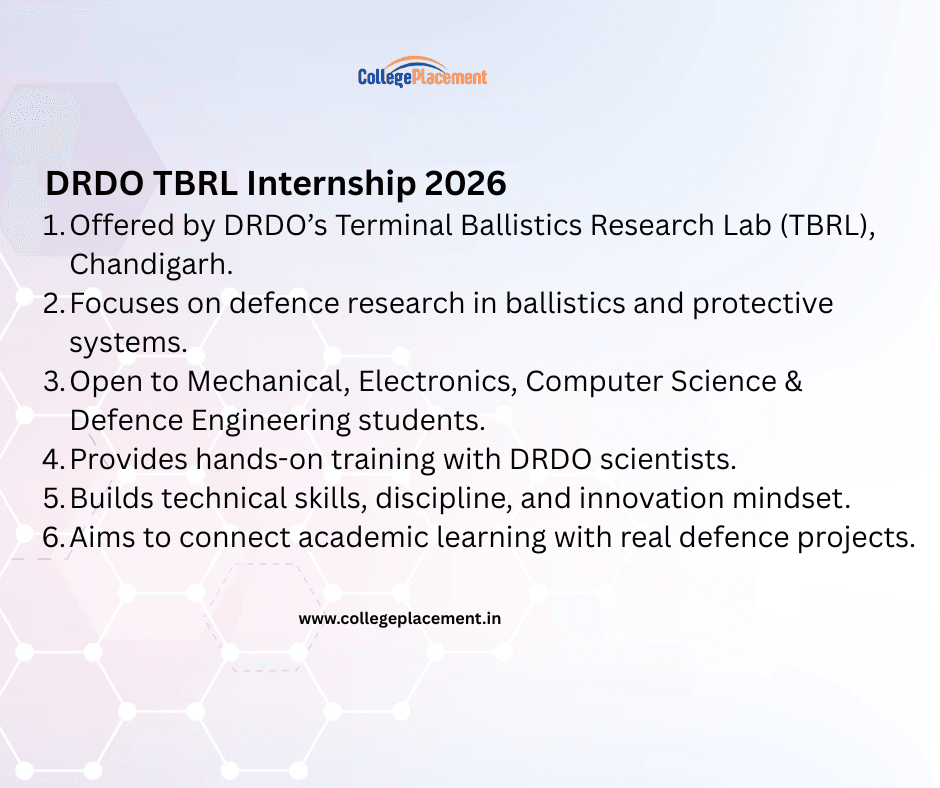
Every engineering student dreams of being part of something bigger — a project that defines innovation, patriotism, and real-world impact. The DRDO TBRL Internship 2026 offers exactly that opportunity. Organized by the Defence Research and Development Organisation’s Terminal Ballistics Research Laboratory (TBRL), this program isn’t just another internship; it’s a gateway to experience India’s cutting-edge defense technology from the inside.
TBRL, located in Chandigarh, focuses on advanced research in ballistics, explosives, and protective systems — the technologies that strengthen India’s defense capabilities. For students passionate about mechanical, electronics, computer science, or defense engineering, this internship brings a rare chance to work alongside top scientists and understand how classroom knowledge turns into real innovation.
The DRDO internship is known for shaping future innovators. Over the years, students who’ve joined TBRL have discovered not just technical growth, but a new level of discipline, curiosity, and respect for applied research. This guide will walk through everything — eligibility, stipend, how to apply, required documents, and preparation tips — ensuring no question remains unanswered.
This detailed guide is brought to you by CollegePlacement.in — a career mentorship platform helping students bridge the gap between academics and real-world placements.
Why the DRDO TBRL Internship 2026 Matters
Unlike short industrial internships, TBRL offers 6-month research-based internships where students work alongside top defense scientists.
Here’s why it’s special:
- You get hands-on exposure to real defense projects.
- You learn from scientists and engineers shaping India’s military technology.
- You earn a government-recognized certificate that stands out in any placement interview.
- You contribute (in a small but real way) to the nation’s innovation ecosystem.
And yes — you get paid for learning!
Stipend Details
One of the most common questions on Google: “Is DRDO internship paid?”
Yes, the TBRL DRDO Internship 2026 is a paid program.- Stipend: ₹5,000 per month
- Duration: 6 months
- Type: Full-time (on-site)
- Working days: Minimum 15 days attendance per month is required to qualify for the stipend.
Though ₹5,000 might not seem huge, remember — this isn’t a corporate internship. It’s a research opportunity under a national organization, which makes it highly respected by recruiters later.
Eligibility Criteria
To be eligible for the DRDO TBRL Internship 2026, you must meet these requirements:
- Education:
- Students pursuing full-time B.E./B.Tech, M.E./M.Tech, or M.Sc from a recognized Indian university or institution.
- Discipline:
- Applicable to branches like Mechanical, Electrical, Electronics, Computer Science, Chemical, Civil, Aeronautical, Physics, and Chemistry.
- Academic Performance:
- Minimum 75% marks or 7.5 CGPA.
- Age Limit:
- Below 28 years as of the date of application.
- Availability:
- Must be able to commit 6 months full-time starting from January 2026.
Important Dates
Event Date Application Start 28 October 2025 Last Date to Apply 17 November 2025 Internship Start January 2026 Duration 6 Months Don’t wait till the last date. Government applications take time for postal delivery, so send your documents at least a week early.
Required Documents
Before applying, prepare the following documents neatly and in order:
- Resume / CV (highlighting academic and project work)
- Bonafide certificate from college
- Recent passport-size photograph
- Copy of valid student ID card
- Academic mark sheets / transcript
- Aadhaar card (as ID proof)
How to Apply for DRDO TBRL Internship 2026 (Step-by-Step)
Unlike corporate internships that take online applications, DRDO TBRL follows an offline application process.
Here’s how you can apply:
- Visit the official DRDO website → DRDO Careers – TBRL Internship
- Download the official notification PDF.
- Read all instructions carefully.
- Print and fill the application form mentioned in the PDF.
- Attach all required documents (listed above).
- Write “Application for Internship at TBRL” on the envelope.
- Send the application via Speed Post to:
Director, Terminal Ballistics Research Laboratory (TBRL), Sector-30, Chandigarh – 160030 - Wait for shortlisting notice or email from DRDO.
Selection Process
The selection process is merit-based and transparent.
- Shortlisting on Academic Merit:
- Candidates with strong academic backgrounds are preferred.
- Interview / Telephonic Interaction:
- In some cases, shortlisted students may be contacted for an online interview.
- Final List & Verification:
- Selected candidates will undergo document and police verification before joining.
Keep your resume simple, factual, and free of exaggerations. DRDO prefers substance over style.
Real-World Mentor Advice
Many students who have applied for DRDO internships under proper mentorship have shared one common insight — preparation and clarity matter more than grades.
- Don’t over-focus on the stipend. Focus on the learning, exposure, and credibility.
- Customize your resume.
- If you’re from Electronics, mention work with sensors or circuit projects.
- If you’re from Mechanical, highlight design tools or ballistics-related mini projects.
- Add a purpose statement. A one-paragraph note on why you want to intern at DRDO adds emotional weight to your application.
- Maintain professionalism. DRDO internships are serious; keep communication polite, formal, and to the point.
- Be patient. DRDO’s selection process takes time — sometimes months. Don’t flood them with follow-up emails.
Internship Location
- Primary Office: TBRL Sector-30, Chandigarh
- Testing Range: Ramgarh, Panchkula (Haryana)
If you’re from Delhi/NCR, it’s very accessible. The lab is about 4–5 hours away by road and well-connected by train.
Certificate & Benefits
At the end of the internship, you’ll receive an official DRDO Internship Certificate signed by the Lab Director.
It’s not just a piece of paper — it’s proof that you’ve worked in a defense R&D environment.Benefits of doing the DRDO TBRL Internship 2026:
- Real-time exposure to defense technology research.
- Valuable learning for GATE / PSU / Research career aspirants.
- Adds credibility for placements in companies like ISRO, HAL, or BEL.
- Network with DRDO scientists and research mentors.
Working at DRDO TBRL isn’t like working in a startup or corporate office.
It’s a place of discipline, focus, and research.- You’ll spend time in labs, data analysis units, and project meetings.
- You may assist in research documentation, simulation modeling, or mechanical design depending on your department.
- Expect mentorship from senior scientists who value curiosity and sincerity more than experience.
Keep a daily journal of your learning. It helps you later in interviews and final report submission.
If you ask me whether this internship is worth it — I’d say absolutely yes.
Every year, hundreds of engineering students chase short, unpaid internships with private startups.
But very few get the opportunity to experience research inside a defense lab.The exposure you get at DRDO — the discipline, the structure, the focus on science — shapes how you see your career.
Even if you don’t end up in defense research, the values you learn here — precision, documentation, teamwork — will stay with you forever.So if you’re reading this, take that step. Download the form. Prepare your documents. And apply before the deadline.
Frequently Asked Questions (FAQs) — DRDO TBRL Internship 2026
1. Is the DRDO TBRL Internship 2026 paid or unpaid?
The internship is unpaid, but students receive an official DRDO certificate upon completion, which holds significant value in research and defence-related job applications.2. Who can apply for the TBRL internship?
Students pursuing B.Tech, M.Tech, or PhD in Mechanical, Electronics, Computer Science, or Defence Engineering from recognized universities are eligible.3. How long does the internship last?
The typical duration ranges from 4 to 8 weeks, depending on project requirements and academic schedules.4. What is the selection process?
Selection is based on academic performance, statement of purpose (SOP), and recommendation letters. Candidates may also be shortlisted based on project fit.5. When will DRDO TBRL Internship 2026 applications open?
Applications generally open between January to March 2026. Students should keep visiting the DRDO official website and CollegePlacement.in for timely updates.6. What documents are needed for the application?
Applicants must submit a resume, recommendation letter, college NOC, and brief project interest statement.7. Can first-year students apply?
No. The internship is mainly open to third- or fourth-year engineering students who have completed basic technical coursework.8. Does DRDO offer a full-time job after the internship?
Not directly. However, many interns later qualify for DRDO Junior Research Fellow (JRF) or other technical roles after completing their degree.9. Where can students get help with applications or SOP writing?
Guidance and templates are available at CollegePlacement.in, where mentors help students refine their documents for internships like DRDO, ISRO, and BARC.10. Is hostel accommodation available for TBRL interns?
Limited accommodation is available at or near the DRDO TBRL campus, usually on a shared or rotational basis.Dear student,
If you’ve ever dreamed of being part of India’s defense ecosystem — this is your moment.
Not every opportunity is about money; some are about exposure, learning, and pride. Apply early.
Prepare seriously and treat this internship as your first mission for India.Still unsure how to apply for the DRDO TBRL Internship 2026?
Don’t worry — our mentors at CollegePlacement.in can guide you step-by-step on resume building, SOP writing, and internship documentation. Start now-Let’s START Your Placement JourneyReach out today and move one step closer to your dream internship — From Degree to Desk.
Ask Us
LATEST POST
- MHA Cyber Crime Internship 2025
MHA Cyber Crime INTERNSHIP: Step Into India’s Digital Defense Network
In an era where cyber threats loom large and digital security is paramount; the Ministry of Home Affairs (MHA) has opened its doors to the next generation of cyber defenders. The Cyber Crime Internship 2025, hosted by the Indian Cyber Crime Coordination Centre (I4C), is a prestigious opportunity for students to gain firsthand experience in tackling real-world cybercrime challenges.
Whether you’re a tech enthusiast, a budding forensic analyst, or a law student curious about cyber legislation, this internship is your gateway to contributing to India’s digital safety.
What Is the MHA Cyber Crime Internship?
The Cyber Crime Internship Program is a flagship initiative by the MHA under its I4C framework. It’s designed to immerse students in the dynamic world of cybercrime investigation, digital forensics, and cybersecurity policymaking.
The internship is offered in two cycles:
- Summer Batch: April to September
- Winter Batch: October to March
Applications for the Winter 2025 cohort are now open, with a submission deadline of October 17, 2025.
Purpose Behind the Program
This internship isn’t just about learning—it’s about contributing. The MHA aims to:
- Equip students with practical skills in cybercrime detection and analysis
- Foster research and innovation in cybersecurity
- Build a talent pool for future roles in digital law enforcement
- Promote awareness of cyber laws and ethical hacking
Interns will work on live projects, assist in investigations, and explore the intersection of technology, law, and national security.
Who Can Apply?
The program welcomes applications from students pursuing:
- Undergraduate (UG) degrees
- Postgraduate (PG) degrees
- Doctoral (PhD) programs
Eligible disciplines include:
- Computer Science & Engineering
- Information Technology
- Electrical & Electronics Engineering
- Cyber Law
- Digital Forensics
- Artificial Intelligence
- Data Science
Applicants must be enrolled in recognized institutions and demonstrate a strong academic record and interest in cybersecurity.
How to Apply
Here’s a step-by-step guide to submitting your application:
- Visit the official I4C portal: i4c.mha.gov.in
- Download the application form
- Fill in your academic and personal details
- Attach the required documents:
- Resume
- Academic transcripts
- Identity proof
- Recommendation letter (optional but recommended)
- Submit your application before October 17, 2025
Shortlisted candidates will be notified within 4–5 weeks after the deadline.
What You’ll Gain
Interns will be exposed to:
- Cybercrime investigation protocols
- Digital evidence handling and analysis
- Threat intelligence and malware tracking
- Cyber law and policy frameworks
- Real-time monitoring of cyber threats
You’ll also participate in workshops, contribute to research papers, and collaborate with experts from law enforcement and tech sectors.
Internship Format
The internship is structured to maximize learning and impact:
- Duration: 3 to 6 months
- Mode: Hybrid (online and in-person depending on assignment)
- Mentorship: Guidance from MHA and I4C professionals
- Deliverables: Weekly progress reports, final presentation, and project documentation
Interns may be placed in specialized units such as:
- Cyber Threat Intelligence
- Digital Forensics Lab
- Legal & Policy Analysis
- Outreach & Awareness
Perks and Recognition
While the internship is unpaid, it offers several career-boosting benefits:
- Certificate of Completion from MHA
- Letter of Recommendation for top performers
- Networking opportunities with cybersecurity experts
- Access to exclusive training sessions
- Priority consideration for future government roles
These credentials are highly valued by employers in cybersecurity, law enforcement, and policy-making.
Why This Internship Matters
India’s digital landscape is expanding rapidly—and so are the threats. From phishing scams to ransomware attacks, cybercrime is evolving. This internship empowers students to:
- Understand the anatomy of cyber threats
- Contribute to national digital safety
- Develop skills that are in high demand globally
It’s not just an internship—it’s a mission to safeguard India’s cyberspace.
Tips to Strengthen Your Application
To stand out:
- Highlight relevant coursework and certifications (e.g., CEH, CISSP, CompTIA Security+)
- Showcase personal projects or hackathon experience
- Write a compelling Statement of Purpose
- Secure a strong recommendation from a faculty member
- Demonstrate awareness of current cybercrime trends
Career Pathways After the Internship
This internship can be a launchpad for careers in:
- Cybersecurity Analyst
- Digital Forensics Expert
- Cybercrime Investigator
- Cyber Law Consultant
- Ethical Hacker
- Policy Advisor
Many interns also pursue advanced degrees or certifications in cybersecurity, law, or public policy.
The MHA Cyber Crime Internship 2025 is a rare opportunity to work at the intersection of technology, law, and national security. For students passionate about digital safety, this program offers real-world exposure, expert mentorship, and a chance to make a meaningful impact.
Whether you’re a student, educator, or recruiter, this internship deserves your attention. Let’s build a safer digital India—one intern at a time.
Would you like me to turn this into a downloadable brochure, LinkedIn post, or email announcement for your college placement cell?
FAQs
What is the MHA Cyber Crime Internship?
It’s a government-sponsored internship by the Ministry of Home Affairs (MHA), offering hands-on experience in cybercrime investigation, digital forensics, and cybersecurity.
Who can apply?
Students pursuing undergraduate, postgraduate, or PhD programs in fields like law, IT, computer science, or cybersecurity. A maximum of 25 UG, 15 PG, and 10 PhD interns are selected per session
What are the internship durations?
There are two sessions:
Winter Internship: October to March
Summer Internship: April to September
Is the internship paid?
Yes, it is a paid internship. Specific stipend details may vary by session
How do I apply?
Applications are typically submitted via the AICTE internship portal or the official MHA site. Keep an eye on i4c.mha.gov.in for announcements
read more
MHA Cyber Crime Internship 2025
MHA Cyber Crime INTERNSHIP: Step Into India’s Digital Defense Network In an era where cyber…
IndiaAI FutureSkills FELLOWSHIP FOR PG Students
IndiaAI Future Skills Fellowship is transforming postgraduate education by offering students across India the opportunity…
What Is the Google Apprenticeship Selection Procedure?
Google Apprenticeships are one of the most sought-after opportunities for students and fresh graduates worldwide….
Latest Post
- IndiaAI FutureSkills FELLOWSHIP FOR PG Students
IndiaAI Future Skills Fellowship is transforming postgraduate education by offering students across India the opportunity to engage in cutting-edge Artificial Intelligence (AI) research and application. This initiative, launched by the Government of India under the IndiaAI Mission, aims to bridge the gap between academic learning and real-world AI deployment.
What Is the IndiaAI FutureSkills Fellowship?
The fellowship is designed to support postgraduate students pursuing AI-related projects, enabling them to contribute to India’s growing AI ecosystem. By providing financial assistance, mentorship, and exposure to industry practices, the program empowers students to become leaders in AI innovation.
Eligibility Criteria
Academic Requirements
Admission Status
- Must have confirmed admission to a PostGraduate program
Application Timeline
- Applications accepted during 1st, 2nd, or 3rd semester only
Academic Performance
- Minimum 80% (or equivalent grade) in undergraduate degree
- For 2nd/3rd semester applicants: Minimum 75% in postgraduate studies through last completed semester
Program Scope
Eligible Disciplines Students from all academic backgrounds are welcome, including:
- Technical fields (Engineering and Sciences)
- Medicine
- Law
- Commerce and Business
- Liberal Arts
- Other disciplines
Project Focus
Must undertake AI-based projects or projects in AI-related domains
Additional Requirements
Study Mode
- Full-time students only (part-time students not eligible)
Nationality
- Open to Indian Nationals exclusively
Fellowship Benefits
Selected fellows receive:
- Financial support up to ₹2 lakh, disbursed in tranches based on project milestones.
- Additional support up to ₹1 lakh for travel and accommodation to present their work at conferences or events.
- Mentorship from leading AI researchers and industry experts.
- Opportunities to collaborate with top-tier academic and research institutions.
Areas of Focus
The fellowship encourages projects in various AI domains, including but not limited to:
- Machine Learning and Deep Learning
- Natural Language Processing
- Computer Vision
- Robotics and Automation
- AI Ethics and Responsible AI
Application Process
The application process involves:
- Project Proposal Submission: Students submit detailed proposals outlining their AI projects.
- Selection Committee Review: A panel of experts reviews applications based on innovation, feasibility, and alignment with national AI priorities.
- Announcement of Fellows: Selected fellows are notified and commence their projects.
Why Apply?
Participating in the IndiaAI FutureSkills Fellowship offers:
- Hands-on experience in AI research and development.
- Exposure to the latest AI tools and technologies.
- Networking opportunities with professionals and researchers in the AI field.
- Enhanced career prospects in academia, industry, or entrepreneurship.
If you’re a postgraduate student passionate about AI and innovation, consider applying for the IndiaAI FutureSkills Fellowship. This is your chance to contribute to India’s AI future and advance your career in a rapidly evolving field.
For more information and to apply, visit the official IndiaAI portal.
Related BLOG
- Prime Minister Internship Scheme: complete guide

Internships have become an integral part of every student’s journey toward building a successful career. Understanding the need for practical exposure, the Government of India launched the Prime Minister Internship Scheme to help students gain hands-on experience while contributing to the nation’s development. This initiative aims to bridge the gap between academic knowledge and real-world applications, ensuring that young India is better prepared for the challenges of the future.
In this blog, we will explore everything you need to know about the Prime Minister Internship Scheme – its objectives, benefits, eligibility, application process, and how it can shape your career.
1. What Is the Prime Minister Internship Scheme?
The Prime Minister Internship Scheme (PMIS) is a flagship initiative by the Government of India (via the Ministry of Corporate Affairs). Launched in October 2024, the scheme aims to provide hands-on industry experience to students and fresh graduates through internships in India’s top 500 companies. Over five years, it aims to offer up to 1 crore internships to youth across sectors.
2. Why It Matters for College Students
- Bridges the gap between theoretical learning and real-world work
- Provides exposure to corporate culture, mentorship, and networking
- Equips you with hands-on skills in sectors like marketing, finance, governance, tech, and more
- Adds a government-recognized certification to your resume
3. Who Can Apply? Eligibility Criteria
To apply for PMIS, you must meet these criteria:
- Age: Between 21 and 24 years (some sources allow up to 30)
- Education: Completed any of the following:
- 10th or 12th pass, ITI certificate, Polytechnic diploma
- Undergraduate degree (BA, B.Sc, B.Com, BBA, BCA, B.Pharma, etc.)
- Postgraduate degree in select cases
- Status: Should not be engaged in full-time employment or a full-time degree (online/distance learners allowed)
- Citizenship: Must be an Indian resident with Aadhaar linkage
- Excluded: Students already in government apprenticeships or scholarship schemes
4. Benefits for College Students
- Monthly stipend: ₹5,000 from the government, plus a one-time ₹6,000 grant for incidentals
- Insurance: Coverage under Jeevan Jyoti Bima Yojana and Suraksha Bima Yojana
- Certificate: Government-issued internship certificate after completion
- Internship options: Opportunities span over 500 companies in sectors like tech, banking, energy, policy, manufacturing, and more
5. Timeline & Application Process
- Scheme announcement: Union Budget 2024–25; portal launched October 2024
- Pilot (Round 1): 1.25 lakh internships, >6 lakh applications across 745 districts
- Round 2 opened Jan–Mar 2025, offering ~1 lakh+ internships across 730+ districts
- Registration portal: pminternship.mca.gov.in needs online profile, Aadhaar verification, SOP, and document upload
- Last known registration: Extended to end of March 2025 (Phase II) and deadlines have been updated per phase
6. Step-by-Step Application Guide for Students
- Register on the PMIS portal with Aadhaar and email/mobile
- Fill your profile, including academic details and SOP (statement of purpose)
- Browse internship opportunities from 500+ companies across sectors
- Apply to relevant postings; waitlist or shortlist-based selection
- Selection process may include further screening or interviews
- If selected, internship may begin with stipend disbursal and assigned period
- Completion leads to government-issued certificate & experience letter
7. Tips to Improve Selection Chances
- Craft a strong SOP: Highlight relevant skills, why you choose that sector, and learning intent
- Customize your profile: Align interests with internship categories (marketing, policy, digital)
- Learn soft skills: Communication, basic Excel/Analytics, domain awareness
- Stay updated with latest deadlines (the portal opens in waves for phases)
- Apply early: Top internships fill up quickly during each round
8. Sample Scenarios for College Students
Discipline Possible Internships What You Gain B.Com / BBA Financial services, Banking, CSR teams Corporate environment, finance skills BCA / B.Tech IT, digital transformation, software firms Coding exposure, collaborative projects Humanities / Policy Govt ministries, Think tanks, NGOs Policy insight, research & writing Marketing / Arts Brand teams, Ad agencies, Social initiatives Campaign design, content creation 9. FAQs — Quick Clarifications
Q. Are reservations applicable?
No explicit government quotas—but companies may ensure diverse representation.Q. Do internships guarantee full-time employment?
No guaranteed job. But strong performance may lead to full-time offers or high-profile references.Q. Can first- or second-year students apply?
Typically, no. Eligibility is for final-year or recent graduates aged 18–30 and not in full-time programmes.The Prime Minister Internship Scheme offers Indian college students a powerful platform to gain hands-on experience, earn a stipend, and build their professional network at top-tier companies. If you’re eligible (aged 21–24, recent graduate or final year student), applying early and aligning your application with your skills and SOP can open transformative opportunities.
By blending government mentorship exposure with real-world work, PMIS can be your steppingstone to stronger career readiness—and even future job placements.
Interested in applying to PMIS? Need help drafting your SOP or choosing relevant internships?
Email us at info@collegeplacement.in for personalized assistance and expert guidance on the application process.Read More
Complete Guide to top Govt Apprenticeships Schemes in India







Utterly written subject material, Really enjoyed reading through.
I’m still learning from you, but I’m trying to reach my goals. I absolutely enjoy reading all that is posted on your site.Keep the aarticles coming. I liked it!
Write more, thats all I have to say. Literally, it seems as though you relied on the video to make your point. You obviously know what youre talking about, why waste your intelligence on just posting videos to your site when you could be giving us something informative to read?